

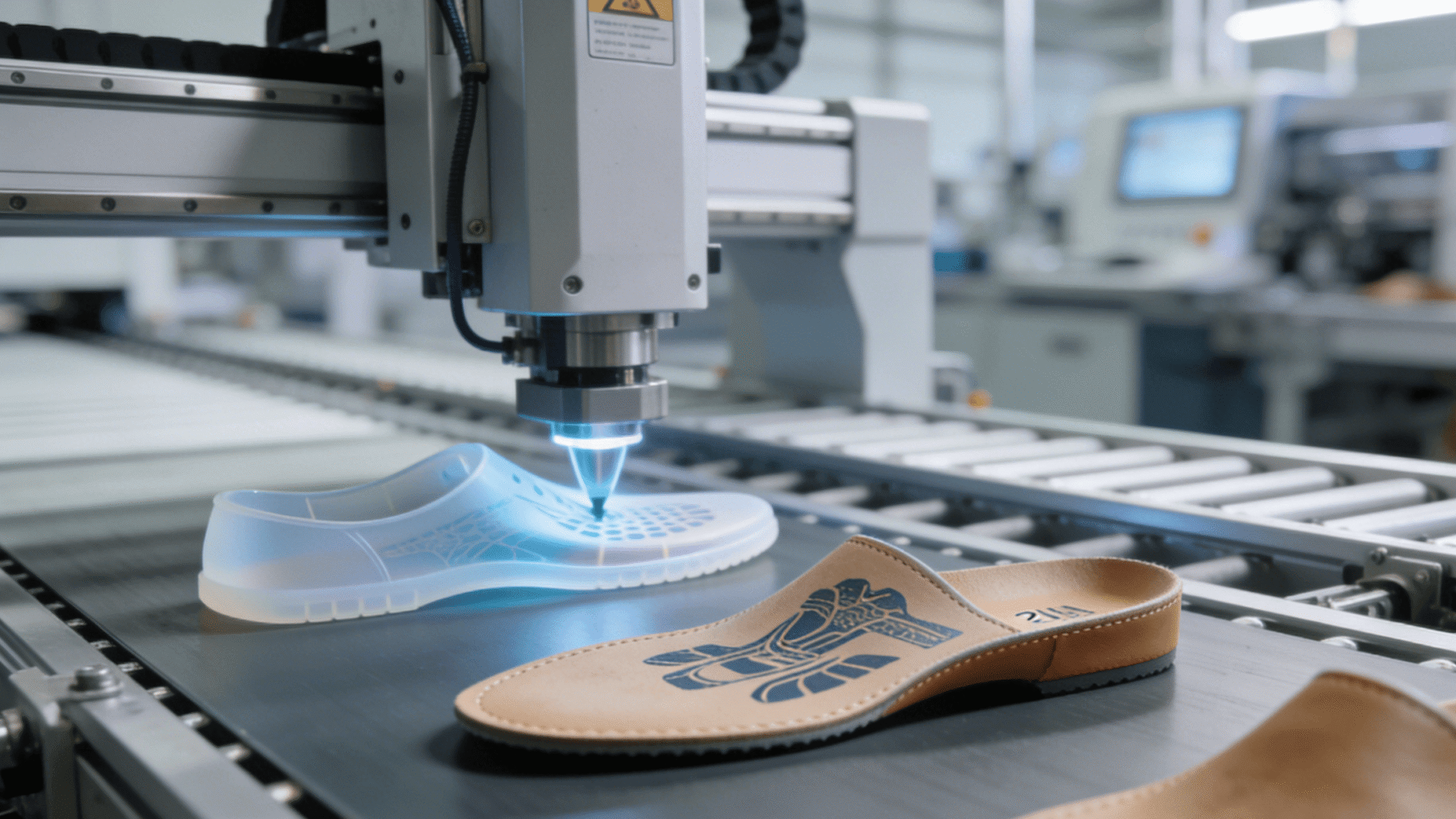
The global footwear industry churns out 24.5 billion pairs of shoes every year. But the real story isn’t the sheer volume anymore—it’s how fast we can make them personal. We are seeing a massive shift from manual assembly lines to shoes printing automation. By using 3D and digital tech, manufacturers are finally cutting down supply chain bloat, lowering costs, and actually making on-demand, sustainable production work. Cnding Group is one of the names pushing this forward. They’ve moved into a space they call “Leading the Future of Footwear Printing with Intelligent Automation,” trying to find that sweet spot between one-off custom orders and massive industrial scaling.
It’s not just a fancy office printer. It’s a specialized process where you apply high-def graphics, textures, or functional coatings directly onto shoe parts. This works on:
Traditional methods usually require physical master plates. Modern shoe printing skips all that. It uses inkjet or sublimation tech to put digital files directly onto 3D surfaces or flat materials. Because they use UV-curable or water-based inks, the results are waterproof and tough enough to handle daily wear without fading.
The jump to automation is becoming a necessity. According to the Footwear Manufacturing Market Report 2025, facilities integrating automation have seen defect rates drop by approximately 17%.
| Feature | Traditional Screen Printing | Automated Digital Printing |
|---|---|---|
| Production Speed | Slow | High-Speed |
| Labor Cost | High (Manual intensive) | Low (Single operator/AI-driven) |
| Waste/Scrap Rate | 8% – 12% | < 2% |
| Customization | Difficult/Expensive | Seamless&Cost-effective |
The primary catalyst for this shift is the personalized footwear sector, projected to reach $12.18 billion by 2031 (12.18% CAGR). Traditional mass production simply cannot keep up with the “one-of-a-kind” consumer demand.
Modern machinery has moved beyond simple mechanics into intelligent ecosystems:
The H18 + X30S Oval Hybrid Digital Printing Machine is the world’s first automated solution specifically engineered for footwear. It fuses screen printing with digital inkjet tech to support up to 12 processes, including slurry, flocking, and UV thick-plate effects.
| Feature | Specification |
|---|---|
| Production Capacity | Up to 600 pcs/h (16-color configuration) |
| Print Head Technology | Industrial-grade Ricoh G5 |
| Resolution | 600 × 1200 dpi |
| Software Integration | Fully ERP Compatible |
| Process Support | Hybrid (Screen + Digital), UV, Flocking, Slurry |
The transition from manual to automated shoes printing delivers measurable gains:
If you’re trying to scale a brand, these are the three areas you need to watch:
| Technology | Best For | Core Advantage | Production Scale |
|---|---|---|---|
| UV Printing | Curved surfaces & TPU | Instant curing & high detail | Small to Medium |
| 3D Printing | Midsoles & Ergonomics | Lattice structures & 60% less carbon | Prototyping/High-end |
| Hybrid Digital | High-volume uppers | Digital gradients + Screen texture | Industrial Mass Market |
Automated printing isn’t just a “cool to have” feature; it’s a strategic move for brands that want to stay relevant.
Brands like Adidas and Nike have already proven this works at scale with 3D-printed midsoles. Meanwhile, in Southeast Asia, Cnding’s hybrid machines are being used to keep production steady in high-humidity environments where older tech often fails.
The global footwear industry is undergoing a seismic shift as it moves away from traditional mass production toward a more agile, technology-driven model. As of 2025, the total footwear market is valued at approximately $476.8 billion, growing at a CAGR of 4.5%. Within this expansion, shoes printing technology is the primary catalyst for disruption.
As a pioneer in the space, Cnding is strategically positioned to bridge the gap between concept and reality. According to our official roadmap, Cnding aims to “lead the future of footwear printing through intelligent automation and breakthrough innovation.” By providing the hardware and software infrastructure for high-speed shoes printing, Cnding enables brands to scale customization without sacrificing efficiency.
As a premier National High-Tech Enterprise in China, Cnding Group has spent over 15 years redefining the standards of footwear manufacturing. Through relentless R&D and a portfolio of over 200 patents, the group bridges the gap between traditional screen printing and modern digital precision.Today, Cnding serves as a strategic partner for 100+ global brands, providing the automation necessary to scale in a competitive market.
At the heart of the industry shift is the H18 + X30S Hybrid System. Specifically engineered for shoes printing automation, this solution addresses the sector’s most critical pain points: consistency and scalability.
Key Features of the System:
What sets Cnding apart in the global market is the pursuit of high yield and extreme precision. In an era where “green” manufacturing is mandatory, Cnding’s technology offers:
The Cnding Promise: “Made by Cnding” is more than a manufacturing label—it is a global synonym for reliability and innovation in the evolving footwear landscape.
The future of footwear belongs to brands that can be fast, sustainable, and personal. Cnding Group provides the hardware and software to make that happen. With over 200 patents and 15 years in the industry, they’ve become a key partner for global brands looking to modernize.
Ready to modernize your production line? [Contact Cnding Group Today for a Custom Automation Audit]
Introduction Custom apparel is hitting massive numbers, with the market expected to pass $45 billion by 2030. If you’re looking at the scene in 2026, Heat Press Vinyl (HTV) is...
Introduction The apparel industry has exploded lately. We’re looking at a market projected to hit $17.5 billion by 2027, mostly because everyone wants custom gear, unique merch, and fast-fashion pieces...
Introduction The custom t-shirt business is on a serious roll. Experts think the global market will hit around USD 5.1 billion by 2026. Even with all the new tech out...